Metroid Prime 4: Beyond Review - I'm Beyond Disappointed


Metroid Prime 4: Beyond was one of my most anticipated games this year, and while it gets plenty right, it ultimately failed to live up to the hype.
Retro Studios worked on Metroid Prime 4: Beyond for nearly a decade, something that worried me greatly when taking my first steps into the game I’ve waited years for. I was pleasantly surprised by the game’s opening, but what was to follow was an upsetting rollercoaster with more downs than ups.
One Small Step For Samus…
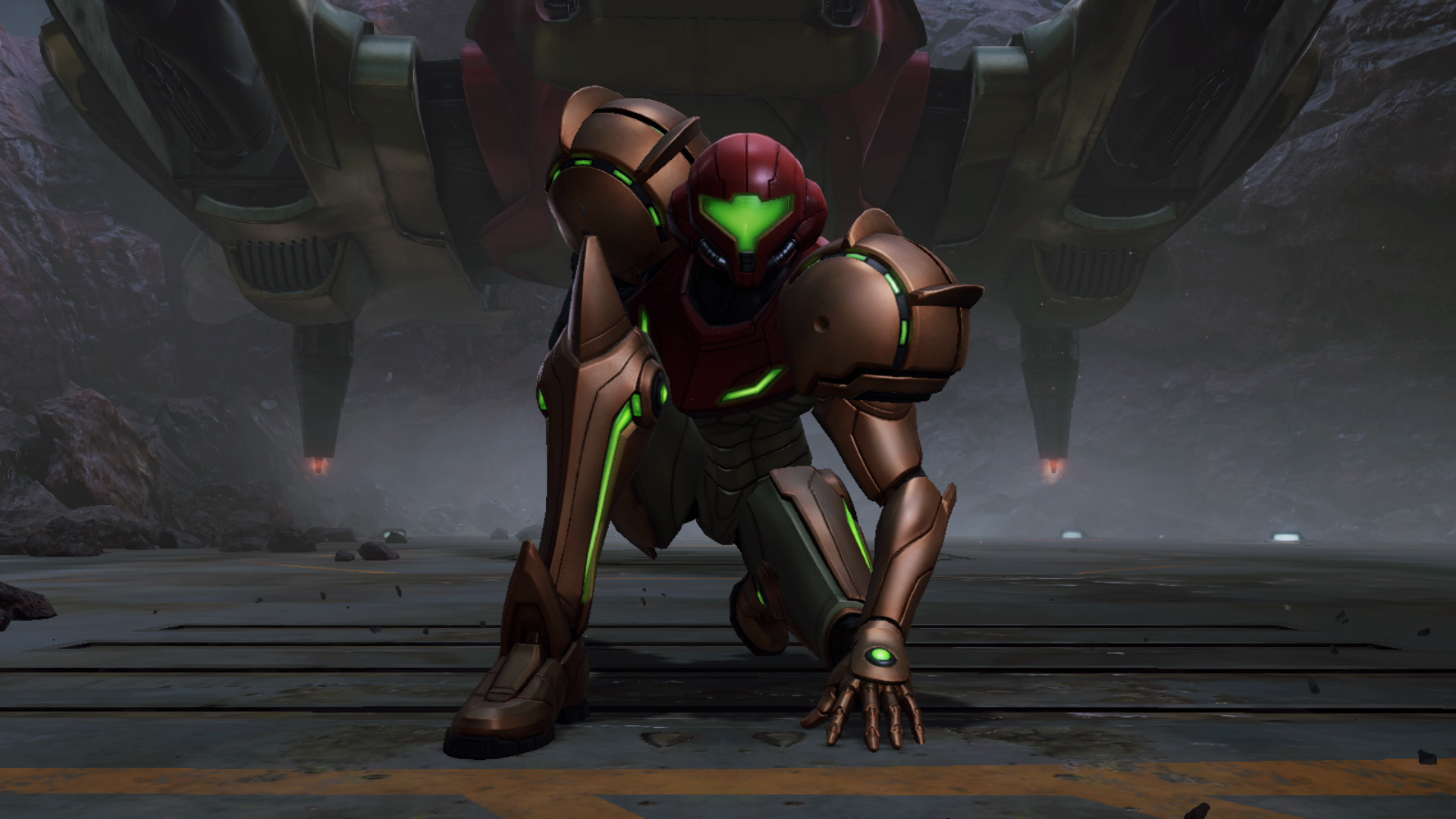
I’ll keep story spoilers to a minimum from here on in, but for some general context, the game begins with a brief tutorial on the core gameplay. Samus’ help is requested by the Galactic Federation as a mysterious artefact is under siege by the Metroid-breeder Sylux, a sworn enemy of Samus and a pivotal character in the story. After an explosive opening segment, Samus is, to no fan’s surprise, flung onto a distant and inhospitable world, stripped of her famed abilities yet again. As I navigated ancient but high-tech structures and eventually stumbled my way into a verdant jungle, I found myself initially in awe of Retro Studios’ work. Through my Nintendo Switch 2, I played on Quality Mode to begin with, and planned to switch to Performance Mode if the game at any point felt like it was struggling to keep up, but to my surprise it never did. This meant I could take in the stunning environments that had been constructed for the game, and really soak in the atmosphere the Metroid Prime games have championed for so many years. Metroid Prime 4: Beyond is no exception. It looks fantastic, and stalking your way through claustrophobic corridors and wide open vistas is still a pleasure for the eyes.
Advert
The game’s environments are incredibly varied, and there was only one key area that lost its lustre as the story went on, which I’ll get to in due time. I was also fond of the new control schemes. While I did sample the Nintendo Switch 2’s exclusive Mouse Mode, I ended up preferring the gyro-controls for when I was free-aiming. That said, the mouse controls worked really well and I wouldn’t be surprised if this was the default control scheme for the majority of Switch 2 players.
Tales of a Bounty Hunter
The story was actually quite strong albeit minus a few surprising additions to the cast. As I said before, Samus finds herself on a strange, new world with a rich history and a post-apocalyptic vibe to it. Remnants of a once mighty civilisation are littered across this alien world and with the in-game scan tool allowing you to learn more about who used to live here and what happened to them. That feels like a mystery worth solving. Much of this is pushed as side content but plenty of context is given during the main story, and I particularly enjoyed Sylux as a villain. He felt imposing, with his hatred of Samus bleeding through his every appearance.
The weaker parts of the story are made apparent very early on, and they’re heavily intertwined with the core gameplay which is where my praise for the game will unfortunately start to drop off. As one of the founders of the genre, I was severely underwhelmed with the metroidvania element of Metroid Prime 4: Beyond. Thinking back on my playthrough, there are three distinct problems with the game that ultimately limited my enjoyment: the world design, the humans, and the back-tracking.
Missing the Mark of a Metroidvania
Metroid Prime 4: Beyond trades the labyrinthian layout you’d expect from a Metroid game for something a little more open-world. Don’t get me wrong, there are still similarities to be drawn between this game and the previous three, and maybe it was my recent replay of Metroid Prime Remastered that set my standards too high, but I found myself shocked by some of the “dungeons”. That’s right, rather than one enormous, interconnected world with several paths to take, Metroid Prime 4: Beyond offers something a little more linear. There are five different areas to explore, all of which are accessible through an open-zone desert area and are not connected to each other like usual. They’re also surprisingly short, with the largest taking me just over an hour to get through.
The desert is the one area of the game that severely outstayed its welcome, and even Samus’ shiny new toy couldn’t alleviate the boredom of traversing it… The VIOLA is the radical ride you’ll have seen in the trailers and while it looks sleek and handles like a dream, its place in the game is nothing more than a way of getting from A to B at a reasonably fast pace.
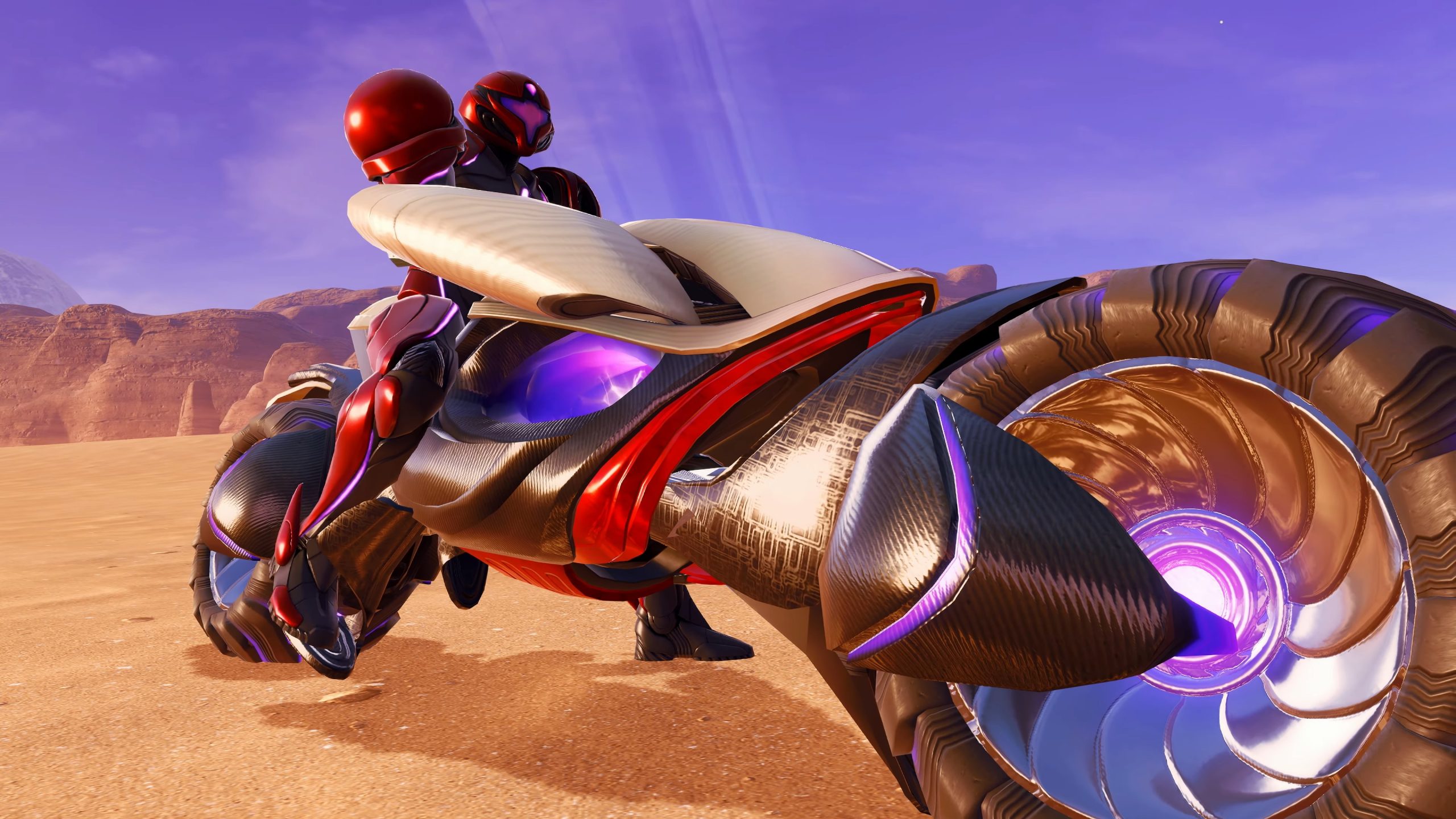
I went into the game expecting the motorcycle to be something akin to the batmobile in Batman: Arkham Knight - something you could ride around on but also use in certain parts of the game to solve puzzles. Unfortunately, the reality was far less exciting as most of my time with the vehicle was spent monotonously holding my finger against the accelerator button and watching Samus drive in a straight line towards her next destination.
Upon arriving at one of the game’s levels, the pace does pick up a bit. Retro Studios has once again crafted some splendidly varied environments and on a visual and technical level, I can’t really fault the studio; it’s just a shame someone placed a big empty desert inbetween them all. I played on normal difficulty and the overall challenge felt consistent throughout the game, even at points where I was missing the odd energy tank. Combat encounters were exciting and like previous games, the enemy design feels smart. They’ll regularly reposition themselves to evade your attacks, so making use of free-aim when you can is paramount to your survival. The enemies themselves could have done with a bit more variety, as even when I was greeted with what the game was presenting as a new type of robot, it was hard to spot any meaningful differences as far as appearance goes.
Puzzles were a strange one. Samus gains new Psychic Abilities that let her interact with parts of the environment with just her mind. During the tutorial, this boiled down to slowly dragging a gemstone across a door, or tracing the outline of a glyph on a surface. It wasn’t very exciting, but I assumed these powers were going to play a prominent role throughout the rest of the game, and was surprised to see that they didn't. They remained consistently flat the entire way through.
The only one of Samus’ abilities I was quite fond of is the Control Beam, which fires three psychic energy balls that the player can direct as time slows to a crawl. While few puzzles took advantage of this neat mechanic, I did find it to be especially useful during boss battles, yet it sometimes felt like I was cheesing them by using it.
A Little Radio Silence Would Go a Long Way
If you caught some of the previews for Metroid Prime 4: Beyond, this’ll be a point you’re familiar with; the humans are annoying. While Metroid games tend to focus on Samus and Samus alone, there are some games where she’s joined by some sort of companion, mostly over comms. Metroid Fusion is a good example of this. In Metroid Prime 4: Beyond though, Samus is joined by five characters and I only liked two of them.
Metroidvanias are worlds you can get lost in, both emotionally and, of course, physically. Finding your way is a big part of their appeal and while it can sometimes lead to frustration when your progression starts to stagnate, you get that rush of accomplishment when you eventually do find your next path. Sadly though, the Federation characters you meet do nothing more than spout exposition and tell Samus what she should be doing and where she can do it. They often accompany you to that destination too and coupled with their deaths being tied to a game-over, you suddenly find yourself babysitting damage-sponges in what should have been a game about exploration. I’ve never liked escort missions and I definitely don’t like them in my Metroid game.
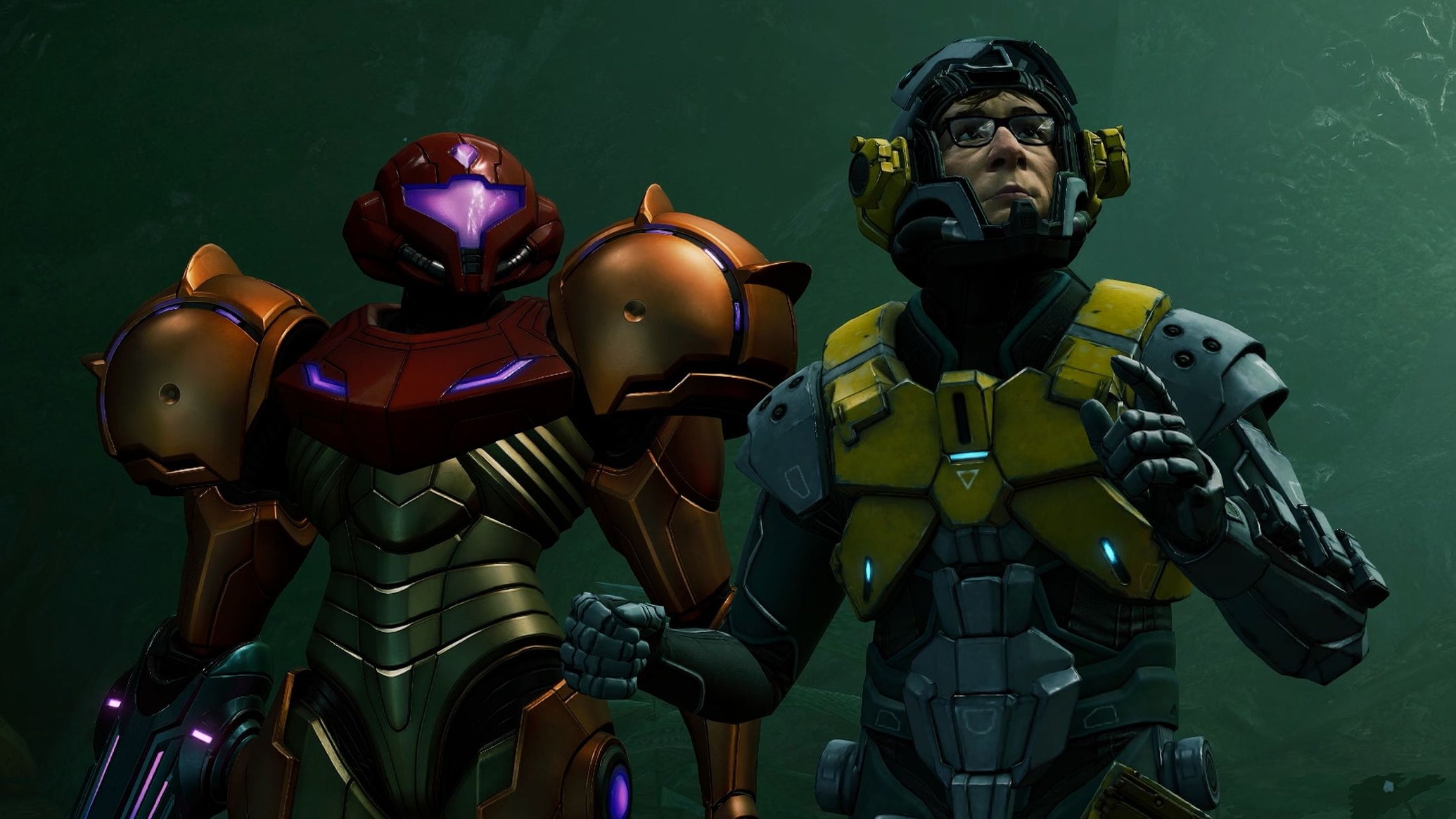
It was incredibly disappointing to me as it felt like such tonal whiplash compared to the rest of the series. When playing a metroidvania, there’s an internal dialogue going on in your head as you’re working out which areas you can go to and which ones you can’t. You’re wondering what you need to do to progress to those inaccessible areas and where you might find it, and again, you feel good when everything starts coming together. That feeling is lost when an NPC with an answer cuts off your train of thought, and that happened far too often in this game. The humans don’t elevate Metroid Prime 4: Beyond; they drag it down.
Myles Mackenzie is the worst of the bunch though. Not because of his non-stop voice lines upon first meeting him but because he’s embedded into the game’s back-tracking. As an engineer, he’s responsible for unlocking Samus’ new weapons which are needed to advance to new areas, thus bringing me onto one of the game’s most unforgivable sins which is the back-tracking in general.
Please, I Don’t Want To Go Back
Perhaps I really did spoil things for myself by playing Metroid Prime: Remastered in the run-up to this game’s launch, but somehow Metroid Prime 4: Beyond made back-tracking in a metroidvania more tedious than I’ve ever experienced. This ties back to the desert and the motorcycle because that is the back-tracking. Here’s a play-by-play of what happened at one point during my playthrough: I fought my way through one of the levels and moved onto another but I needed a suit upgrade to make my way inside. I had to drive all the way back to the previous area to get said upgrade but there was no extra part of the level involved, it was just inside but unobtainable until I triggered the right cutscene. So, I drove all the way back to the area I wanted to go to, but now something new was blocking my path and I needed a weapon upgrade for it. Then, I went to an entirely new area to get the weapon upgrade but only Mackenzie can help you equip it, prompting yet another desert drive to get back to the starting area, and then another drive back to the area I actually wanted to explore. It wasn’t fun.
Back-tracking works when there are options but Metroid Prime 4: Beyond is too linear so it just feels tedious. By the end of the game, I had around 70% of collectables and no desire to return to previous areas and get the rest even if they’d be helpful for the final battle. While I’ve never strived for 100% completion in any previous Metroid game, I’d always at least make a point of getting all the energy tanks but every time I considered it during this playthrough, I got visions of crossing that damn desert. The worst part is there are hundreds of green crystals sprouting out of the sand, which Samus can smash into pieces and absorb as a collectible. These crystals are a necessary part of beating the game and I spent a good hour towards the end collecting the amount I needed to access the final boss.
Mission Incomplete
Metroid Prime 4: Beyond has been eight years in the making and yet it unfortunately misses the mark in several ways. As the biggest Metroid Prime game to date, it’s fallen into the trap that many open-world games succumb to, having an overwhelming feeling of emptiness. The actual levels themselves are good, look great, but are dragged down by interfering NPCs and linear layouts that defeat the point of a metroidvania entirely. Part of me suspects Retro Studios’ intention was to make a Metroid Prime game for those who are new to the series entirely, because it has all the makings of a reboot rather than a sequel, which would have been fine if it was named and marketed as such. It pains me to be so critical because I was so excited to love it, but this release left me so, so disappointed.
Pros: Stunning visuals and performance on Nintendo Switch 2, solid story
Cons: Misses the mark of a good metroidvania, annoying side characters, pain-staking backtracking
For fans of: Metroid Prime: Remastered, Metroid: Dread
6/10: Good
Metroid Prime 4: Beyond launches on Nintendo Switch and Nintendo Switch 2 (version tested) on 4 December 2025. A review code was provided by the publisher. Read a guide to our review scores here.
Topics: Reviews, Nintendo, Nintendo Switch 2, Nintendo Switch